

How to pay at Stanley Market: cash, card, Octopus and QR
Stanley runs on three counters, and they do not take money the same way. The bus and the green minibus take an Octopus tap or exact cash. The pitches in the market lane work in notes. The shops in Stanley Plaza and the sit-down restaurants take cards. The taxi is the newest of them: since 1 April 2026 every Hong Kong taxi must offer two kinds of electronic payment as well as cash.
Sort the Octopus before you arrive, because it pays for the journey in and for anything with the sign on it once you are there. Then carry notes for the pitches, and read the code on a counter before you scan it.
Cards and contactless at the till
A card pad on the counter is the test that matters. Where there is a contactless pad or a card slot, the amount comes up in Hong Kong dollars before you tap and the transaction is done in a second. Where the pad is absent or turned away, the counter is a cash counter.
The shops in Stanley Plaza and the restaurants are where a card pad is normal; a pitch sells from a table, a box or a rail, so at a pitch the pad or the sign on the stall is what settles it. In a small café, ask before you order rather than after — a shop with one till and no pad is not going to find one for you at the end of the meal.
Hong Kong has no VAT or GST, so the figure on the board is the figure the pad charges, with nothing added at the end.
A wallet rides on the same pad: AlipayHK works through Apple Pay wherever the Apple Pay or contactless mark is shown.
Octopus: buy it before the bus
Octopus is the card the transport is built around. It is accepted anywhere you see the Octopus sign — the MTR, buses, ferries, public light buses, coaches and trams, plus bakeries, fast food, HK-style cafés, coffee shops, cinemas and theme parks, across more than 180,000 acceptance points.
An On-Loan card is the one to buy. It comes from an MTR Customer Service Centre with a HK$50 deposit, refundable when the card goes back, plus stored value: HK$150 on an adult card, HK$50 on a child or elder card, HK$130 on a Personalised one. Every station issues them except Airport, Hin Keng, Kai Tak, Lei Tung, Lo Wu, Lok Ma Chau, Racecourse, South Horizons, Sung Wong Toi, To Kwa Wan and Wong Chuk Hang. There is no station in Stanley, so buy the card at the station you start from.
Arriving with a phone instead: the Octopus App for Tourists puts an Octopus on an iPhone X or later, or on an Apple Watch Series 3 or later, and it tops up with a non-Hong Kong Mastercard, UnionPay or Visa card, the e-CNY App or Weixin Pay.
The tourist card sold over the counter is a different product — HK$39, no stored value and no deposit. The HK$39 is not refundable, and any value left on it comes back only by deactivating the card.
| Card | You pay | Stored value | When you leave |
|---|---|---|---|
| On-Loan, adult | HK$50 deposit | HK$150 | Deposit comes back with the card |
| On-Loan, child or elder | HK$50 deposit | HK$50 | Deposit comes back with the card |
| On-Loan, Personalised | HK$50 deposit | HK$130 | Deposit comes back with the card |
| Tourist card, sold | HK$39 | None | HK$39 is not refundable |
Cash is the simple way to top up: add value at an Octopus Authorised Add Value Service Provider, up to HK$3,000 in one go, at 7-Eleven, Circle K, Wellcome, ParknShop, McDonald's and Starbucks.
A full card matters more than it sounds. Stored value runs to HK$1,000 on an older card and HK$3,000 on a card issued on or after 1 December 2019, and on a Mobile Octopus issued on or after 1 October 2019. One tap can also take the balance below zero — by up to HK$50 on a card issued on or after 1 October 2017, by up to HK$35 on an older one — so a small balance does not strand you at a gate.
On the way to Stanley the card buys you a shorter queue, not a cheaper ride. Citybus publishes one adult fare per route with no cash-and-Octopus split, so the tap and the coins cost the same:
| Route | Adult fare | Notes |
|---|---|---|
| 6 | HK$11.4 | Citybus, same on Octopus and in cash |
| 6A, 6X | HK$11.7 | Citybus, same on Octopus and in cash |
| 260 | HK$15.1 | Citybus, same on Octopus and in cash |
| Green minibus 40 | HK$13.1 | Jardine's Bazaar to Stanley Village, full fare |
The Citybus fare is the same on Octopus and in cash — the bus page takes each route in turn, so you can match the fare to the stop you want.
Refunds, if you are flying home with a balance: HK$11 or 1% of the remaining value, whichever is higher, is charged when the card goes back within 90 days, when the balance is over HK$1,000, or when the card has been used for five transactions or fewer. Under HK$1,000 is paid at any MTR Customer Service Centre on the spot; HK$1,000 or more goes back to Octopus Cards Ltd, with the money through within nine working days.
QR wallets: what is promised, what happens, what to check
Three different things are called paying by QR in Hong Kong, and they are not the same rail. The first is a wallet's own merchant acceptance: the till carries the Alipay or Alipay+ mark and the cashier reads the payment code in your App. The second is the interbank link between Hong Kong's FPS and Thailand's PromptPay, which has its own participant list. The third is cash and card, which always work. A wallet being on the second rail says nothing about the first, and the other way round.
PROMISE: what the wallets advertise
AlipayHK is on the first rail. It claims over 150,000 partner merchants in Hong Kong, and its own destination page for cross-border payment names the Chinese mainland, Macao, Japan, South Korea and Singapore against a broader claim of over 100 countries and regions. Registration takes a Hong Kong mobile number and an SMS. An overseas Visa or Mastercard can be linked for spending and cross-border payment, with availability, limits and functions depending on the issuer and on what the App displays, and the wallet states no additional fee for cross-border payment on designated methods while the bank or card issuer may charge for the transaction, the exchange rate or a cash advance.
The interbank link is FPS × PromptPay, launched on 4 December 2023 by the Hong Kong Monetary Authority and the Bank of Thailand and operated by HKICL and NITMX, with HSBC and Bangkok Bank settling. The Hong Kong side is seven banks — Bank of China (Hong Kong), BOCOM (Hong Kong), Bank of East Asia, Citibank (Hong Kong), Fubon Bank (Hong Kong), Hang Seng and HSBC — and three stored-value facilities: HKT Payment, Octopus Cards Ltd and Yintran. AlipayHK is not on that list. The link runs in both directions, so a PromptPay-side wallet can pay a Hong Kong merchant that displays an FPS QR.
How the code is built changes what you do with it. A static QR is one you type the amount into; a dynamic QR arrives with the amount already filled in. The exchange-rate quote on a static code expires after a short period and has to be refreshed before you confirm.
Octopus appears on this page twice over, and the two are not the same thing: the plastic card you tap on a bus, and the Octopus Wallet in the App, which is one of the three stored-value facilities on the FPS × PromptPay list. The wallet's Thai route changes nothing about what a Stanley pitch will take.
PRACTICE: what happens at a counter
The one counter in Stanley where QR is a legal requirement is the taxi. Since 1 April 2026 every Hong Kong taxi driver must offer at least two electronic means: one QR, such as AlipayHK, WeChat Pay HK or BoC Pay, and one that is not a QR, such as an Octopus card, a credit card or FPS. Cash continues. The stickers on the cab's windows say what that car takes, and you can ask before you get in.
Where a cross-border QR fails, the code itself is usually the reason, and the operators say so: Octopus's PromptPay page carries a footnote that some non-participating Thai banks' QR codes, and PromptPay personal QR codes, do not support the FPS × PromptPay payment. A code that belongs to a person rather than to a merchant is not the tier the scheme was built to route.
CHECK: how you tell before you pay
Read the counter before you scan. A printed stand carrying the Alipay or Alipay+ mark, with a fixed amount or a till that reads the code in your App, is a merchant code — the rail a wallet is advertised for. A handwritten QR, or a phone screen showing a personal name or a phone number as the payee, is a personal account code: somebody's own account, not the shop's till. Try it once; if the App refuses, stop and do not resend.
On the FPS side the test is the same in different clothing: the shop's code carries the FPS mark and a merchant name. A personal FPS QR — a phone number or an email address as the payee — is the person-to-person form. It may work, but it is not the shop's till and it gives you no receipt.
When a QR will not settle it, the fallbacks go in order: ask for the shop's merchant QR, pay in Hong Kong dollars cash, or draw cash from an ATM.
ATMs and cash
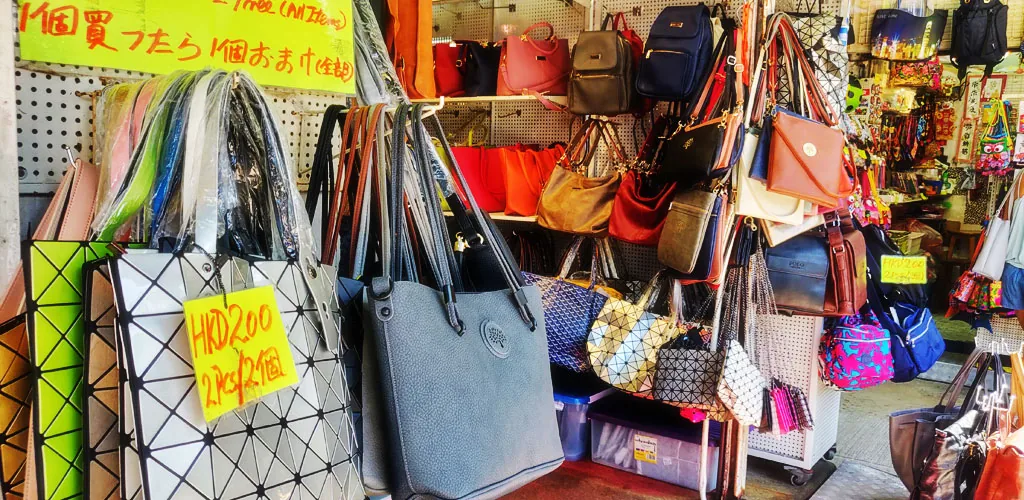
Notes are the working money at the pitches. Haggling is the local convention, opening around 30–40% below the asking price, and an agreed price is settled with notes in your hand rather than at a till — so draw before you walk down the lane.
At a Hong Kong ATM the fee is set by the bank that issued your card, not by the bank whose machine you are standing at, and the machine puts the charge on screen before you confirm. The withdrawal limit per transaction is your own bank's as well.
The machine dispenses Hong Kong dollars, which is the currency the pitches price in and the currency a taxi meter runs in.
The stalls and the restaurants: two different counters
The market lane is licensed rather than leased, and that shapes the day. FEHD's fixed-pitch licence window is 6 a.m. to 11 p.m. daily, and an individual pitch may keep hours of its own, so the stalls run to a different clock from the shops around them. The covered Stanley Waterfront Mart is a separate building again: an FEHD public market open 07:00 to 22:00 daily, and it keeps a fixed day, unlike the pitches outside.
Money follows the same split. At a pitch a price is agreed and settled in notes unless the stall shows a card pad or an Octopus sign. At the shops and the restaurants, Octopus is taken anywhere the Octopus sign is shown, and a card pad is the usual till.
What the pitch in front of you takes is written on it rather than set in a rule book: the sign on the table, the code taped to the box, or the question you ask before you pick something up. How the stalls take money and how to haggle is set out for the lane as a whole.
Tipping: the 10% is usually on the bill
Restaurants settle the question for you. Most add a 10% service charge, though some cafés and diners do not, and unrequested tea, condiments or snacks are added to the bill as well. The line to read is the service charge, not the amount left on the table.
At a pitch there is no bill and no service line: the price agreed is the price paid.
Check before you pay
- The mark. An Octopus sign, an Alipay or Alipay+ mark, or a card pad. If none of the three is on the counter, ask, and keep enough cash for it.
- The code. A printed merchant code with a mark and an amount is the shop's till. A handwritten code, or a phone screen carrying a person's name, is somebody's own account — if the App refuses it, stop.
- The amount. The pad, the Octopus reader and the wallet all show Hong Kong dollars before you confirm, and a rate quote that has lapsed has to be refreshed.
- The service charge. Read the bill for 10% before adding anything to it.
- The fallback. Cash in Hong Kong dollars, and the ATM screen shows its fee before you confirm.
All details correct at time of publication.